Microfiber couches are comfortable, practical, and good at hiding everyday dirt—until a greasy armrest, spilled drink, or mysterious dark patch appears. Cleaning the fabric seems a simple enough task, but the wrong product can leave water rings, stiff patches, or marks that look worse than the original stain.
The best way to learn how to clean a microfiber couch is to check its upholstery care code before you grab a cleaner. Some microfiber fabrics can handle water-based cleaning products, while others require a compatible solvent. Some couches should be vacuumed or professionally cleaned.
Knowing what your couch can take will go a long way in helping you to get rid of everyday dirt, work on specific stains, and reduce the chances of damaging the fabric.
Table of Contents
How to Clean a Microfiber Couch
- Check the care code first. W, S, W-S, or X will tell you what cleaning methods may be appropriate.
- Before cleaning, take off any crumbs, dust, pet hair, and loose debris from the cushions and seams.
- Use a compatible cleaner: Some fabrics use water-based products; others require an appropriate solvent.
- Test a hidden spot: Check for color change, texture damage, or residue before cleaning a visible area.
- Do not soak upholstery: too much moisture can penetrate the cushions, leading to uneven drying or water marks.
| Care Code | General cleaning procedure |
| W. | A water-based upholstery cleaner for use with a compatible fabric |
| S& | A solvent-based upholstery cleaner that is compatible |
| W-S( | Water or solvent-based products approved by the manufacturer |
| X | Vacuum or professionally clean; do not use household cleaning products without specific approval. |
Always follow the instructions on the couch manufacturer and the cleaning product label. These codes are a starting point, not permission to use every product within a category.
Find Your Microfiber Couch Cleaning Code First
Before deciding how to clean microfiber upholstery, look for the manufacturer’s care instructions. A method that works on one microfiber couch may damage another, even if the fabrics look nearly identical.
The cleaning code tells you which general cleaning approach the manufacturer recommends. It can help you avoid using water on fabric that needs solvent-based care or applying a household product to upholstery that should only be vacuumed.
Where to Locate the Upholstery Care Tag
Start by checking the usual places furniture makers put upholstery information:
- Beneath removable cushion covers
- under the couch frame
- On the underside of the upholstery
- On the manufacturer’s label on the furniture
Look for a letter like W, S, W-S, or X. The tag can also contain care instructions, product limitations, or a model number.
If you can’t find a label, try to find the brand and model of the couch, or contact the manufacturer. Don’t try water, alcohol, or other cleaning products until you have found a suitable method.
What Do W, S, W-S, and X Mean?
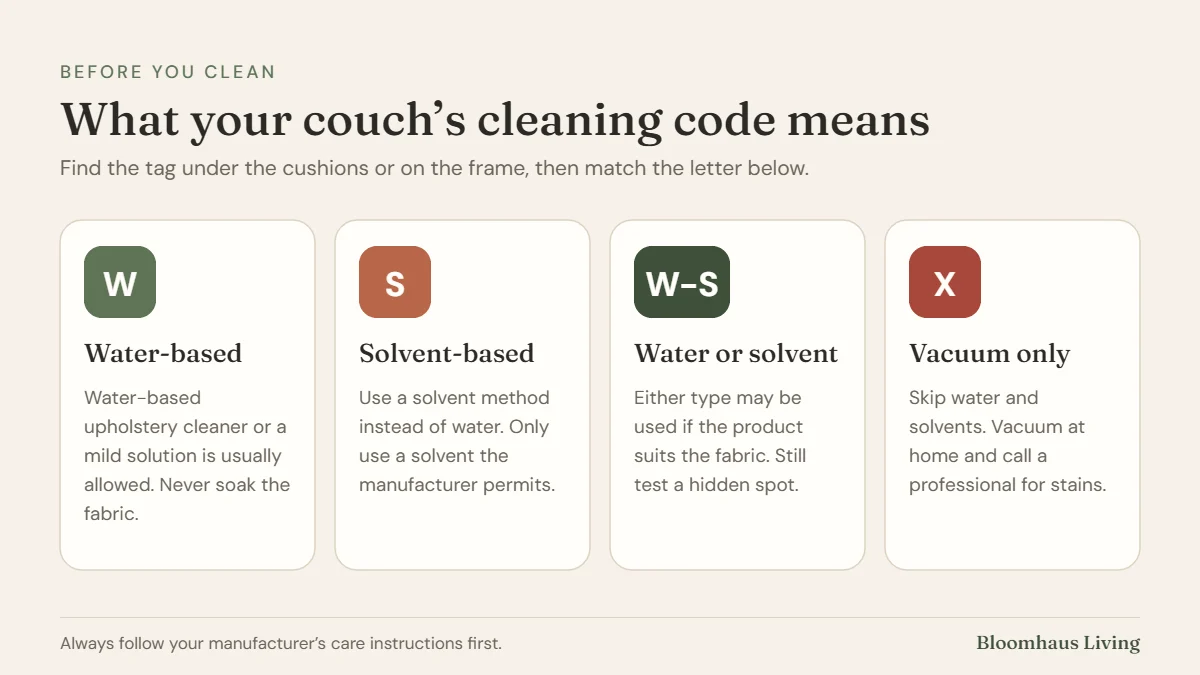
W – Water-based cleanup
A W code usually means that water-based upholstery cleaning methods are allowed. Depending on the manufacturer’s instructions, this may include an appropriate upholstery cleaner or a mild cleaning solution.
W does not mean you should soak the couch. Use only the amount of moisture the cleaning method requires, and follow the product’s directions.
S – Cleaning with solvent
An S code typically means the fabric needs a solvent-based cleaning method and not one that uses water.
Do not assume that every household solvent is suitable. Rubbing alcohol, for example, should only be used when the manufacturer’s instructions permit it and the product is appropriate for the fabric.
W-S — Water-based or solvent-based cleaning
A W-S code generally permits either category of cleaner, provided the specific product and method are compatible with the upholstery. You should still test the product before treating a visible area.
X — Vacuuming or professional cleaning
An X code generally means you should avoid water-based and solvent-based cleaning products unless the manufacturer provides specific authorization. Vacuuming is the usual at-home starting point. For stains, contact the manufacturer or a professional upholstery cleaner.
Codes can vary slightly between brands, so treat the tag as your starting point. For a manufacturer’s overview of the four codes, see American Leather’s guide to explaining fabric cleaning codes.
What if there’s no cleaning code on your couch?
Look up the manufacturer’s care guide using the brand and model number. If the furniture is secondhand, ask the seller for its original documentation if available.
Do not treat the absence of a label as permission to use whichever method seems easiest. You don’t know what the fabric requires? It is safer to get professional advice than to try an unknown product on the whole couch.
How to Clean a Microfiber Couch Using Soap and Water
Use this method only if the cleaning instructions for your couch call for water-based cleaning. Usually small amounts of appropriate cleaner and controlled moisture are easier to handle than a heavily wet cloth or a bucket of soapy water.
Collect Your Cleaning Supplies
Depending on the manufacturer’s instructions, you may need:
- “Vacuum cleaner with upholstery attachment
- Microfiber cloths, clean, light color
- Soft bristle brush or proper sponge
- A bowl of water,
- A water-based upholstery cleaner or a mild soap solution, if allowed
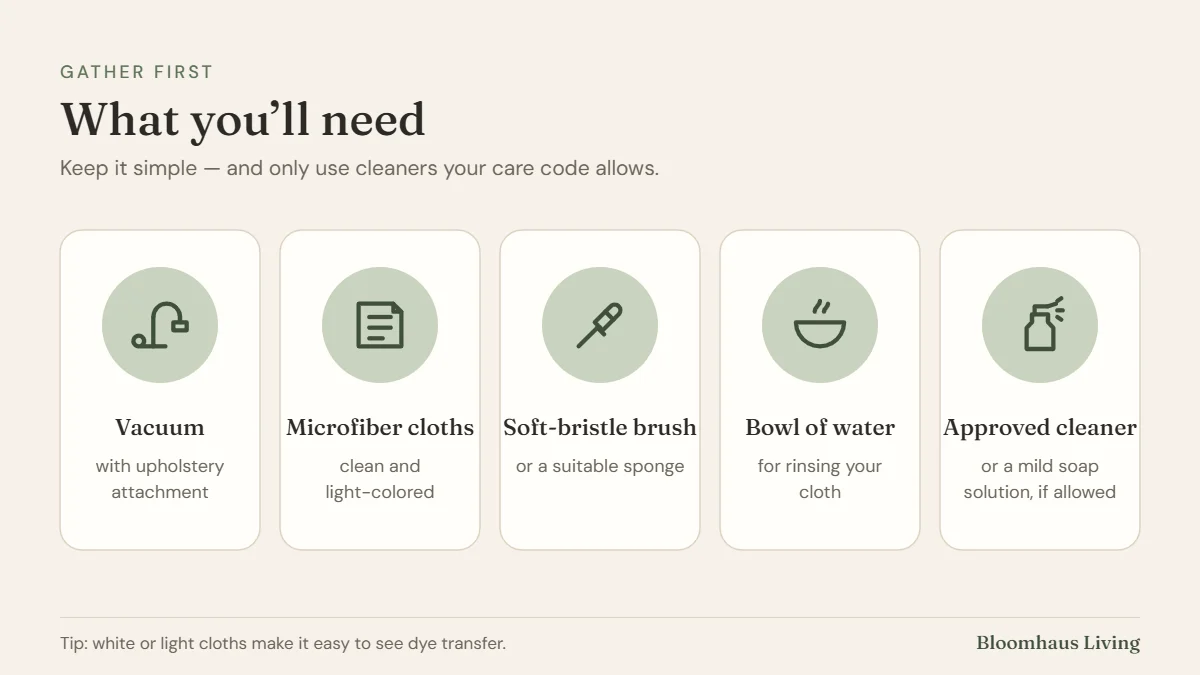
Don’t use a lot of different cleaning products all at once. If the fabric changes color, feels sticky or develops a visible ring, it is easier to determine the cause by a simple method.
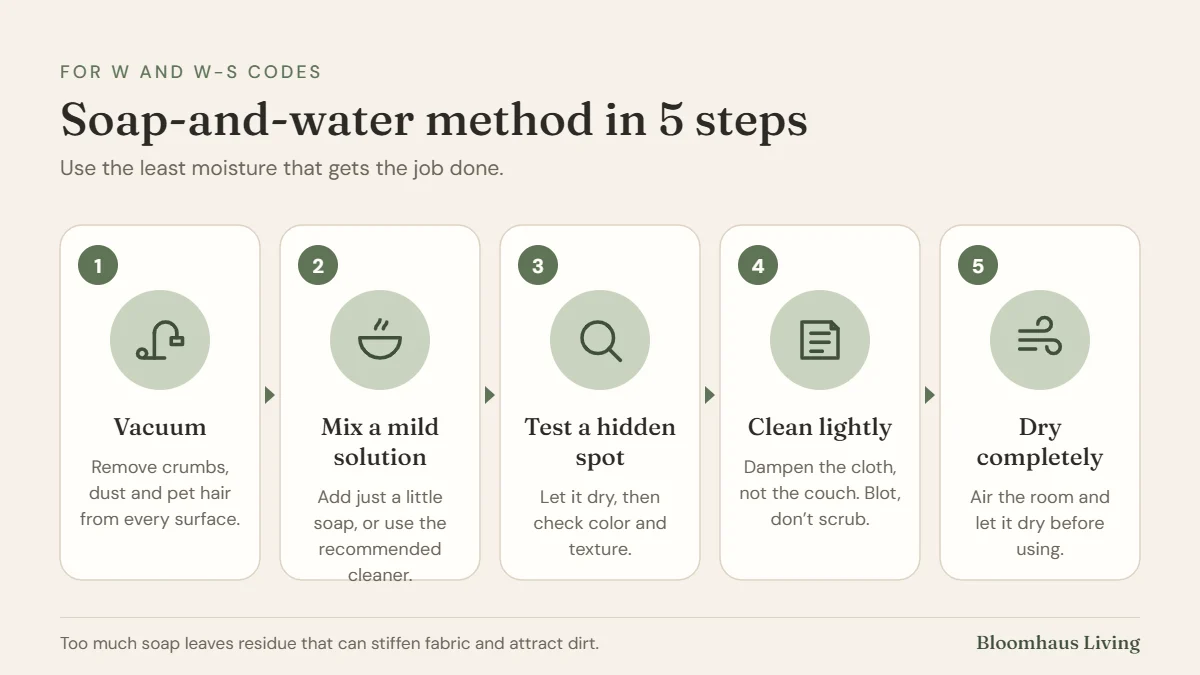
Step 1: Vacuum the whole couch.
Remove loose dirt before applying any liquids. Otherwise dust and crumbs can combine with moisture and be more difficult to remove.
Take off removable cushions and vacuum both sides if the manufacturer’s instructions allow it. Use the upholstery attachment to clean:
- Cushion seams and piping
- Gaps between seat cushions
- The space beneath removable cushions
- Armrests and the backrest
- Areas where pet hair and crumbs collect
Move slowly around seams and crevices. Removing loose debris first also makes it easier to see which marks actually need wet cleaning.
Step 2: Create a Mild Cleaning Solution
Read the label on the cleaner and the care instructions for the couch. If mild soap solution is permitted, add a little soap—not too much—in the hope of getting better results.
Overuse of soap can leave a residue that makes the fabric feel stiff or attract dirt after washing. If the manufacturer has recommended a particular upholstery cleaner, use it rather than some homemade concoction.
Step 3: Test a Hidden Area
Choose an inconspicuous spot, such as a concealed section beneath a cushion, where practical. Use the same tool and technique you plan to use on the visible upholstery to apply the proposed cleaner.
Let the test area dry thoroughly before evaluation. Look for any discoloration, stiffness, change in texture, or a visible ring.
If the fabric reacts badly, stop. Don’t go on to clean the rest of the couch like that.
Step 4: Clean with the Least Moisture
Work in small sections; don’t soak the couch all at once.
- Li: Use the cleaning tool indicated by the product or slightly dampen a clean cloth.
- GeGently treat the soiled area without vigorous scrubbing.
- Avoid saturating the fabric, seams, and cushion interiors.
- Recleaner residue as directed on the label of the product.
- Move to next section only when you are satisfied with the cleaning process.
The dirt will be sectioned and transferred to a clean area of the cloth. Rubbing repeatedly with a dirty cloth will spread the soil instead of cleaning it.
Step 5: Let the couch dry completely.
Let the upholstery dry according to the manufacturer’s instructions. Always work in a well ventilated area. Do not apply any other products to the fabric when it is still damp.
Check the cleaned area in natural light when dry. If the fibers look flattened, brush gently if the manufacturer permits it.
How to Clean a Microfiber Couch Using Rubbing Alcohol
Rubbing alcohol is sometimes used to clean some microfiber upholstery, but it’s not a universal solution. It may be suitable for some fabrics, which can be cleaned with solvent-based cleaning, while others may discolor or react badly to it.
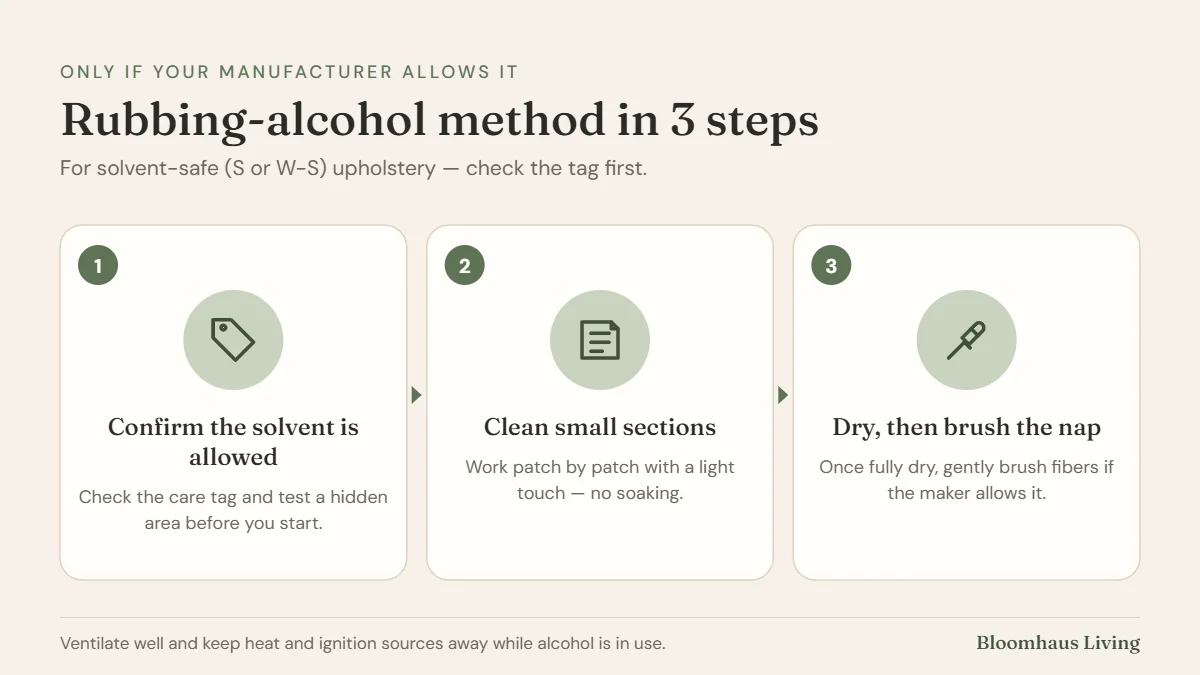
Check the care code and manufacturer’s instructions before proceeding.
Step 1: Selecting the right solvent
Only use rubbing alcohol if the manufacturer allows that type of solvent and the product is suitable for the upholstery.
Try a secret spot first. Once dry, check for any changes in color, texture, or appearance. If the fabric does not react as expected, stop and find another approved cleaning method.
It’s important for safety: Rubbing alcohol (flammable) Avoid contact with flames, sparks, cigarettes, hot surfaces, and other sources of ignition. Use in a well-ventilated area. Follow the product label. Never mix with any other cleaning product.
Step 2: Clean Small Parts
First, vacuum the couch to remove any loose debris. Follow the directions on the cleaner, including whether to apply it to a cloth or directly to the fabric.
Use only the amount needed to treat the affected area. Gently blot or work on the soil with a clean, light-colored cloth or suitable soft brush, depending on the product directions.
Avoid flooding seams or cushion interiors. If a stain begins to spread, the fabric changes appearance, or the method fails to improve the mark, stop rather than repeatedly applying more solvent.
Step 3: Let the fabric dry and shake it out again
Dry upholstery thoroughly in a well-ventilated area. Keep heat and ignition sources away while the alcohol is in use and while flammable vapors may remain.
After drying, inspect the area in natural light. If the fabric’s nap looks flattened, gently brush it only if the manufacturer’s instructions allow it.
How to Get Stains Out of a Microfiber Couch
The best way to remove a stain depends on what caused it and which cleaning methods your upholstery permits. Check the care code first and then select a complementary product.
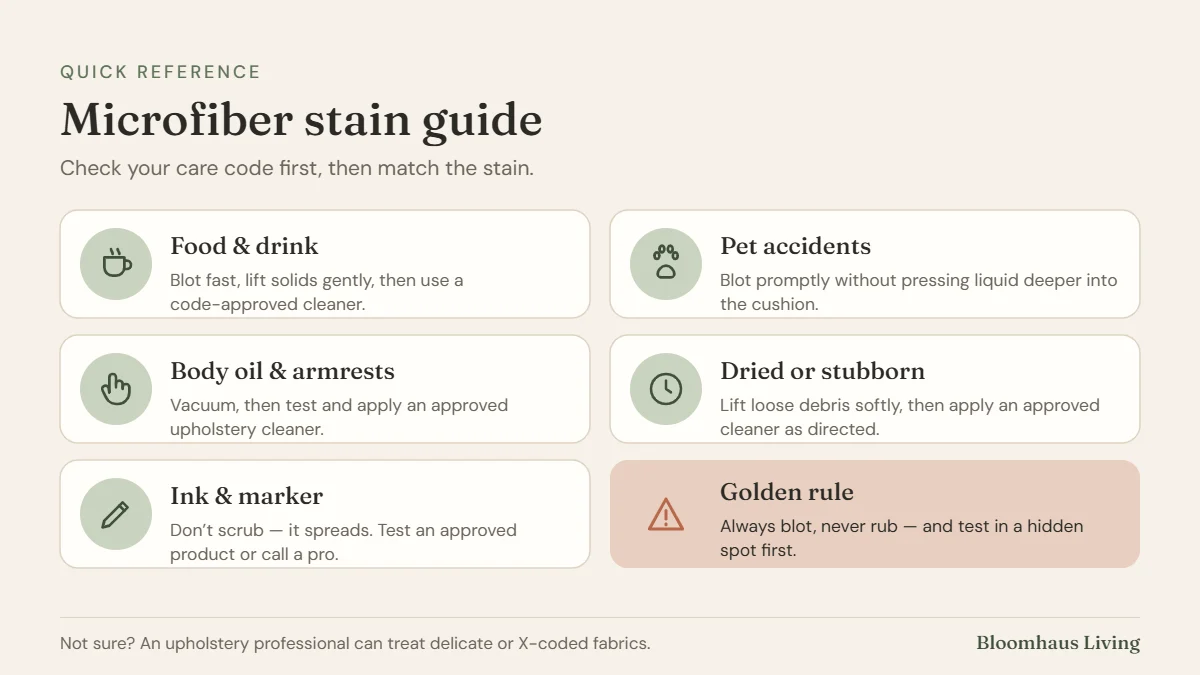
Fresh Food and Drink Spills
Work quickly, but do not rub the spill further into the fabric.
- Blot liquid with a clean cloth to absorb as much as possible.
- Lift solid food residue carefully with a suitable blunt tool.
- Use a cleaner compatible with the couch’s care code.
- Follow the product’s instructions for treating and drying the area.
Don’t push hard enough to get liquid into the cushion. If the spill is colored liquid, blot carefully enough to be able to see if there is a stain left.
Body-Oil Marks and Greasy Armrests
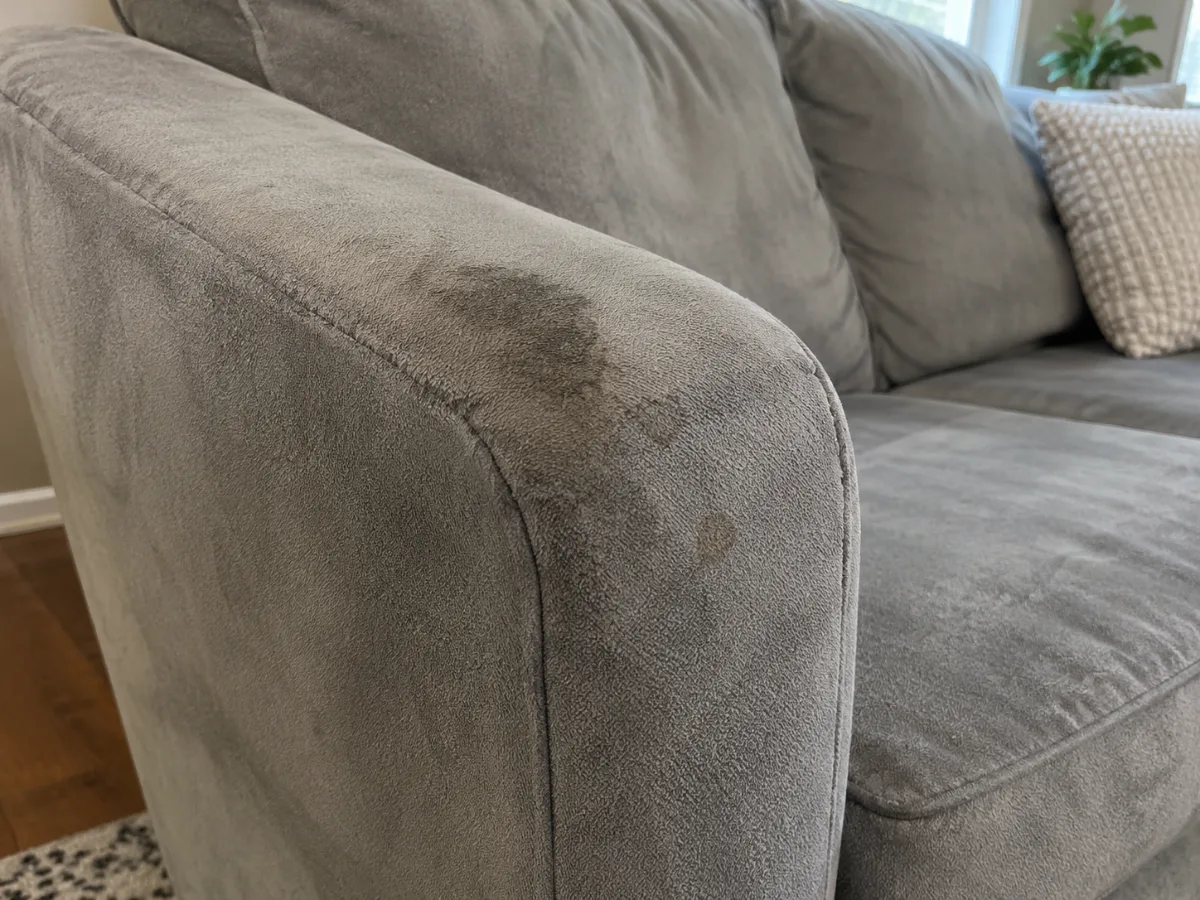
Armrests, headrests, and areas of seats that are used a lot can become discolored by body oils and everyday grime. Vacuuming will pick up loose dirt, but oily buildup may require a compatible upholstery cleaner.
Apply the approved product according to its label and test it first. Do not automatically switch to rubbing alcohol because the stain looks greasy.
An absorbent powder may be appropriate for some upholstery, but only use one if the manufacturer permits it. Remove the powder thoroughly with a vacuum and avoid leaving residue in the fabric or seams.
Ink and Marker Stains
Ink can spread quickly when rubbed, so resist the urge to scrub the mark.
Blot carefully where appropriate, and confirm that the fabric permits the proposed cleaner before applying it. Although alcohol may help with some ink stains, it is not safe for every microfiber couch.
For a large ink mark, an old stain, or a stain that spreads during treatment, consider professional upholstery cleaning rather than experimenting with increasingly strong products.
Pet Accidents and Lingering Odors
Blot fresh moisture promptly using clean absorbent cloths. Avoid pushing the liquid deeper into the cushion.
Choose a cleaner compatible with the upholstery and appropriate for the type of accident. Follow its instructions for treating both the stain and the source of the odor.
Masking an odor with fragrance does not remove the material causing it. The visible surface may look clean if liquid has gotten into the cushion, but the odor-causing residue is still trapped inside. For deeper contamination, a professional may be needed.
Stains that are dried or stubborn
Start by softly lifting off loose debris without scraping or damaging the fibers. Next, apply an approved cleaner per its directions.
Where applicable to stain and product, work from the outside edge toward the center to help limit spreading. Don’t soak and scrub the same spot repeatedly.
If a careful try does not lift the stain, stop and reassess. Repeatedly doing it can wear down the fabric, leave residue, or create a bigger stain..
How to Remove Water Rings From a Microfiber Couch
Water rings can appear when moisture dries unevenly, when a cleaning product leaves residue, or when the fabric’s fibers change direction. Not every visible ring is actually a water stain, so identify the problem before treating it again.
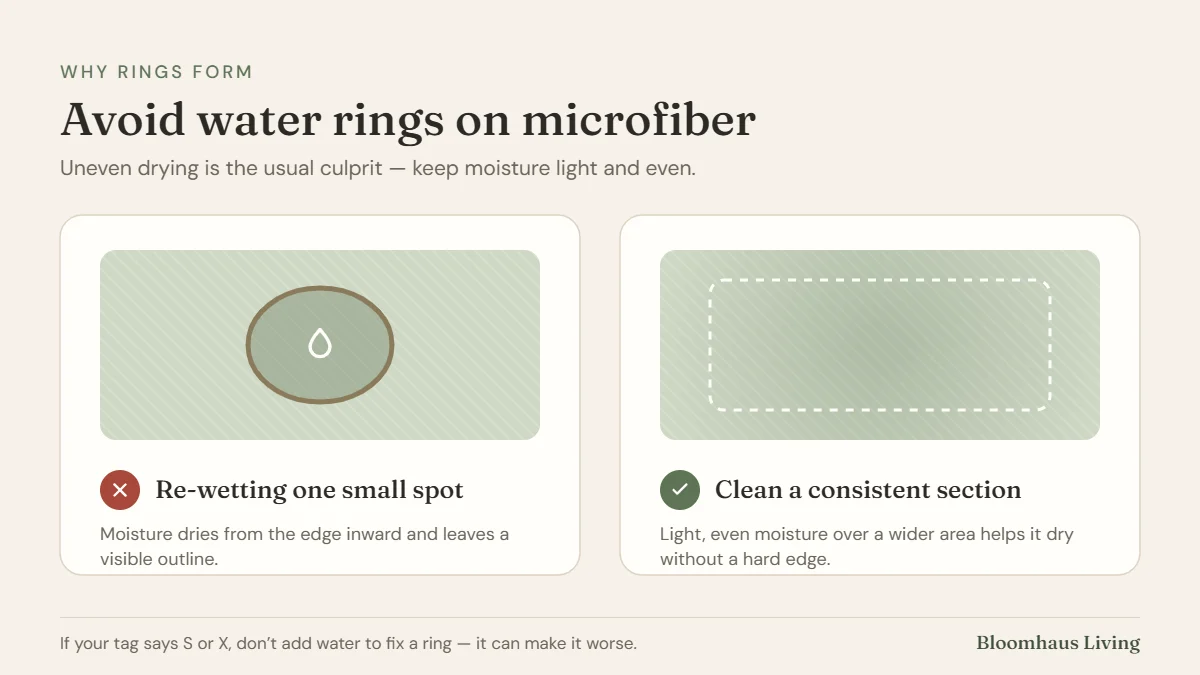
Start by checking the care code. If the couch requires solvent-based cleaning, adding water in an attempt to remove a ring may make the problem worse.
For upholstery that permits water-based cleaning, follow the manufacturer’s recommended method. In some cases, cleaning a consistent section rather than repeatedly wetting one small spot may help prevent a noticeable difference between the treated and untreated areas. But don’t use it if the fabric can’t take it.
If you think there is cleaner residue, follow the product instructions for removal, not adding more cleaning solution. Allow the fabric to dry completely and then verify that the mark is still there.
If the ring persists, or the fabric feels stiff, looks discolored, or has a changed texture, consult the manufacturer or a professional upholstery cleaner.
[TESTING NOTE TO ADD] Document the original mark, the approved treatment used, whether a larger area needed attention, the drying time, and the final appearance. Do not claim that a method removed the ring unless the result was actually observed.
Common Microfiber Couch Cleaning Mistakes to Avoid
A few common mistakes can turn a manageable cleaning job into a bigger problem.
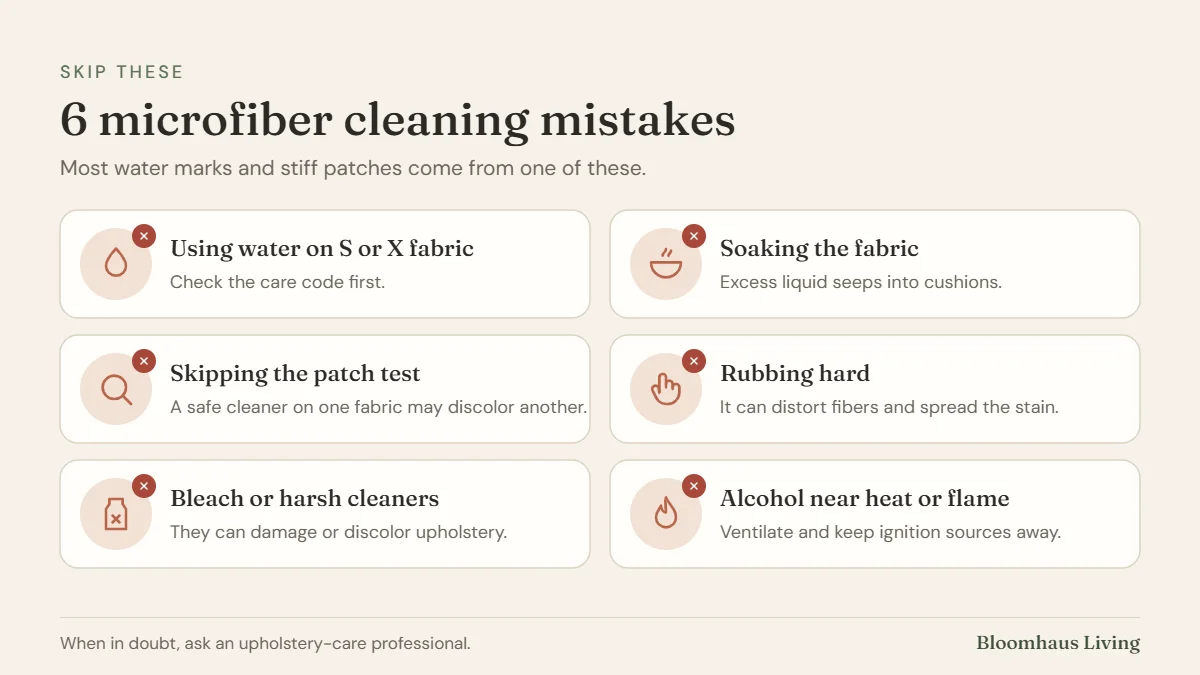
- Using water on incompatible upholstery: Check the care code before applying a water-based product.
- Soaking the fabric: Extra liquid can get into cushions, resulting in slow drying or uneven marks.
- Skipping the hidden-area test. One cleaner that works on one fabric might discolor another.
- Vigorous rubbing: Rubbing vigorously may distort fibers, spread stains, or change the texture of the fabric.
- Do not use bleach or strong household cleaners unless approved. Such products may harm the upholstery or alter its color.
- Spreading alcohol near an ignition source: Solvent products should be handled with care and good ventilation.
- When wet, the couch will get dirty, and the fabric will look different until it dries because of moisture. Let it dry completely before you can judge the result.
- Mixing cleaning agents: Mixing products can result in hazards or undesired reactions Read the label and use one product at a time that is compatible.
How Often Should You Clean a Microfiber Couch?
The right cleaning schedule depends on how often you use the couch, whether you have pets or children, and how quickly dirt builds up.
Vacuum: Extra attention should be paid to seams, cushion crevices, and areas that trap crumbs or pet hair. Blot up spills as soon as possible and remove any visible grime before it becomes hard to remove.
Deep-clean upholstery based on its condition and the manufacturer’s recommendations, not on some random schedule. Too much cleaning product can leave a residue or cause unnecessary wear to the fabric.
For routine maintenance, a vacuum with a suitable upholstery attachment is a useful starting point. Use liquid cleaners only when the couch needs them and the care instructions permit the chosen method.
[ORIGINAL PHOTO NEEDED] Photograph a real maintenance session showing the upholstery attachment, the area being vacuumed, and the condition of the couch before cleaning.
Frequently Asked Questions
Can I clean every microfiber couch with soap and water?
No. First, look up the care code on the couch and the manufacturer’s instructions. Some microfiber upholstery can be cleaned with water-based products, while others can be vacuumed or cleaned with solvent-based products only.
Is it okay to use rubbing alcohol on microfiber upholstery?
Only when the manufacturer’s instructions permit a suitable solvent-based method and the product passes a hidden-area test. Rubbing alcohol is flammable, so keep it away from ignition sources and use it with appropriate ventilation.
What does an S cleaning code mean?
An S code generally indicates that the fabric requires an appropriate solvent-based cleaning method rather than a water-based one. It does not mean every solvent is safe to use.
How do I clean a microfiber couch without leaving water marks?
Begin with the care code to choose the appropriate cleaner, and apply only a little moisture. Read the instructions for the product and give the upholstery enough time to dry before you assess the outcome. If a ring develops, ensure it is not due to improper drying, residual cleaning product, or change in fabric texture before re-treating.
Can I use a steam cleaner on a microfiber couch?
Don’t assume that steam cleaning is safe for all microfiber couches. Heat and moisture affect upholstery differently depending on the type of fabric, construction, and cushion materials. Check your manufacturer’s instructions for your particular model before using steam.
What should I do if I cannot find the cleaning code?
Consult the care guide, identify the brand and model of the sofa or contact the manufacturer. If you are unsure about how to clean the fabric, it is better to seek professional advice rather than try an unknown cleaner.
Why is my microfiber couch hard after washing?
Possible causes can be cleaning residue, a change in the fibers of the fabric, or an improper cleaning method for the upholstery. Let the couch dry completely, check the product instructions, and do not add more cleaner without finding out what is going on. If the stiffness does not go away, contact the manufacturer or an upholsterer.
Summary: How to Clean a Microfiber Couch Safely
Find the care code on your sofa. Remove loose dirt. Choose a compatible cleaning method. Use as little moisture as possible where necessary. Test the product on an inconspicuous area. Allow the upholstery to dry thoroughly before evaluating the result. If there is no label, the stain is persistent, or the fabric feels odd, consult a professional instead of risking damage to the garment.
Looking for more ways to keep your main gathering space fresh and inviting? Browse our living room ideas or read our story to see what Bloomhaus Living is all about.
Leave a Reply